
Size is one of the most useful ways to choose an urchin—and one of the easiest ways to misunderstand one. The category grew from several bait families and maker traditions, so there is no universal rule that says the number on the package must mean outside diameter, center-body diameter or total arm span.
Package size is not a common ruler.
If two straight worms are labeled 4 inches, you can reasonably expect both to be about 4 inches long. Urchins are different because they have two obvious scales at once: the compact center body and the much wider circle made by the arm tips.
Some current makers explicitly publish both. West Coast Baits, for example, lists one model with a 5/8-inch center body and 2.5-inch overall profile, and another with a 3/4-inch center body and 4-inch overall profile. Connecticut Custom Lures likewise publishes a 5/8-inch center and 2.5-inch outside diameter on one of its urchins. That is useful because it shows exactly why one number cannot fully describe the bait.
If the maker does not say, treat the listed size as a product name until you can verify the actual body and overall span.
Separate the body from the whole profile.
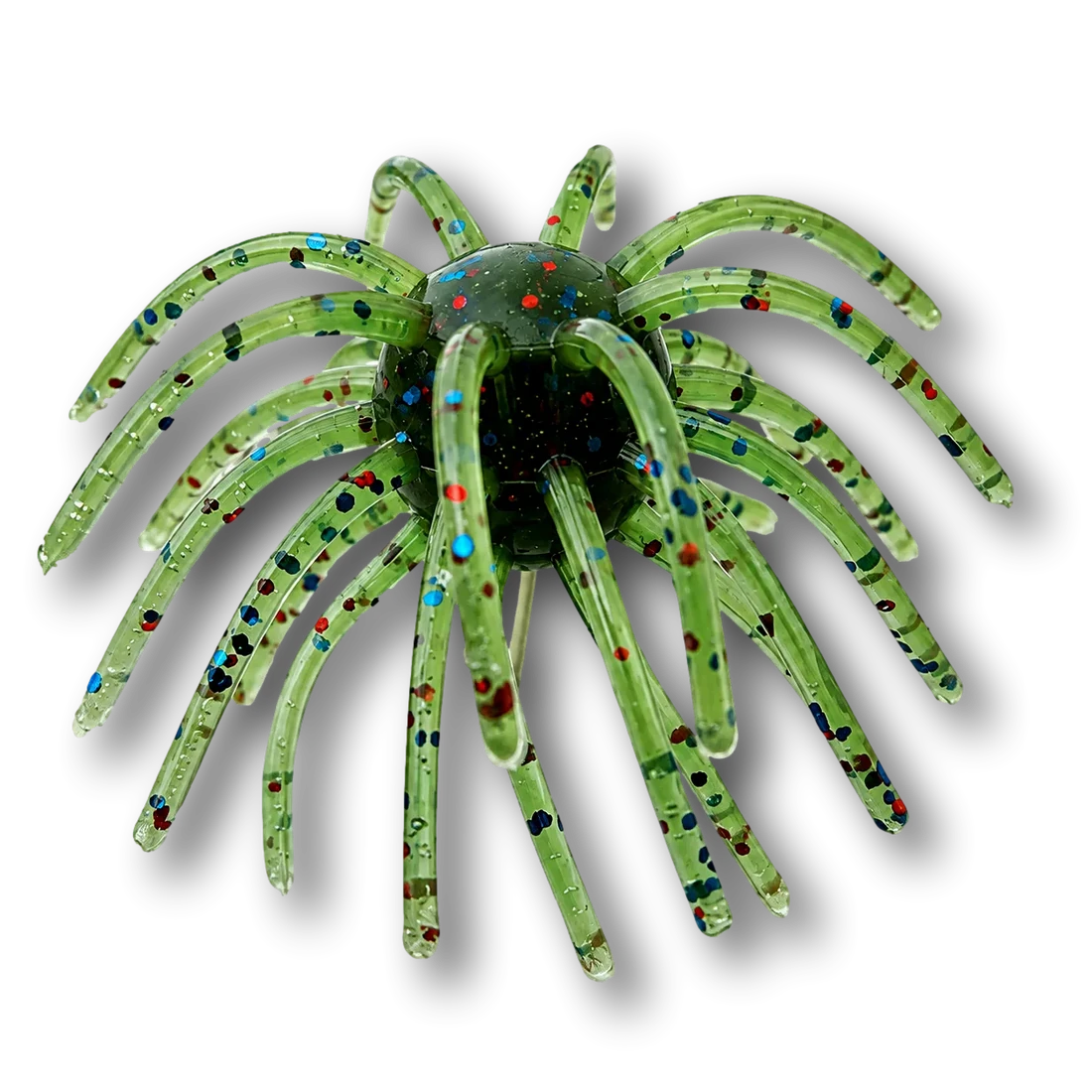
Use two plain-English measurements.
Body size is the diameter or width of the center ball/core. Tip-to-tip size is the distance across the entire bait from the end of an arm on one side to the end of an arm on the opposite side.
- Body size helps predict hook fit, weight capacity and how much plastic must collapse on a bite.
- Tip-to-tip size helps predict visual presence, how much water the bait catches and how large the profile appears to a fish.
- Arm count, arm thickness and material still matter even when those two measurements are identical.
A third number can also matter: body weight. Two baits with the same outside span can fall very differently if one has a dense salted center and the other uses a lighter floating material.
Think in fishing jobs, not rigid inch cutoffs.
Because the measurement systems are inconsistent, hard universal boundaries create false precision. These classes are better used as practical buckets based on what the bait can comfortably do.
| Working class | What usually defines it | Common jobs | What to watch |
|---|---|---|---|
| Micro | Small center body, light overall mass, arms fine enough to work on tiny hardware | Micro jig, float, ice, crappie, panfish, trout/light tackle | Oversized hook or head can dominate the bait |
| Compact finesse | Enough body for bass-size finesse hooks while staying relatively small tip to tip | Drop shot, Ned, hover/light jig, BFS/light spinning | Hook clearance and fall rate |
| Full-size | Substantial center body and/or wide outside span that carries larger hardware | Suspended bass, weightless, internal-weight, heavy drop shot, cover-oriented rigs | Body thickness, specialized hook fit, storage/material |
A large fish can eat a micro bait and a smallmouth can eat a full-size urchin. Size changes presentation first—fall, visibility, hardware and water resistance—not the species printed on the package.
A bigger outside span does not simply mean “more bait.”
More tip-to-tip size
Longer arms create a wider target without requiring the same solid mass as a thick creature bait. Fish can see a large profile while the center remains relatively compact.
More arm area
More or longer arms can slow the fall and exaggerate pauses. Two baits with equal outside size can still differ if one has 20 thick arms and the other has 40 fine ones.
More body size
A larger center gives you more plastic to rig, but it also gives the hook more plastic to clear. That is why body diameter matters separately from overall size.
More center weight
A dense body can cast farther and sink faster even when the outside span resembles a lighter, more buoyant bait.
Choose the hook for the body and the weight for the job.
Overall span matters to the fish; center-body size matters to the hook. That distinction becomes obvious when two baits share a 2.5-inch outside profile but one has a much thicker middle. The thicker bait may need more working gap even though both look equally large from a distance.
| If this gets bigger... | Usually re-check... | Because... |
|---|---|---|
| Center body | Hook gap, hook length, keeper style | More plastic has to collapse and clear the point |
| Tip-to-tip span | Fall rate and water resistance | Longer arms catch more water and can slow or stabilize the bait |
| Solid body weight | Added lead/tungsten | The bait may already cast and sink well without much external weight |
| Arm density | Hook exposure and grass resistance | More material can crowd the hook or catch vegetation |
Use a five-line comparison instead of the package name.
Write down the body size.
If the maker does not publish it, measure across the center at its widest point.
Write down the tip-to-tip size.
Measure across opposite arms without stretching them unnaturally.
Note the material.
Regular plastisol/PVC, stretchy TPE/elastomer, salted, unsalted, floating or sinking all change behavior.
Note arm density and arm length.
Outside size alone does not tell you how much water the profile catches.
Rig both for the same job.
Only then compare fall, posture, hook clearance and how much motion remains during a pause.
Current products show why the category needs two measurements.
The point here is not to rank these baits. It is to show that makers are already describing the profile in different ways.
| Example | Published size language | What that tells the angler |
|---|---|---|
| West Coast Baits Variant-16 | 5/8-inch center body; 2.5-inch overall | Both hook-room scale and full visual span are explicit |
| West Coast Baits Variant-20 | 3/4-inch center body; 4-inch overall | Larger body and much wider outside profile |
| Connecticut Custom Lures Ironclad Shot | 5/8-inch center; 2.5-inch outside diameter | Again separates center from total profile |
| HIDEUP Coike family | Models use names such as 13mm and 17mm alongside larger variants | Do not assume those numbers are directly comparable with inch-based outside-span labels from other makers unless the measurement basis is confirmed |
This is exactly why this site uses body size and tip-to-tip size as separate terms. The product name can still be useful; it just is not enough by itself.
Common size questions.
Is a 17mm urchin smaller than a 2.5-inch urchin?
Not necessarily. The two numbers may measure different parts of the bait. Before comparing them, find out whether each number describes the center body, the entire outside span or simply a model name.
Should I choose a smaller urchin in clear water?
Sometimes, but clarity alone does not decide it. Smaller profiles can reduce visual presence and fit lighter hardware; larger profiles can still be effective in clear water when fish are willing to inspect a slow suspended target. Start with presentation, pressure and forage size rather than a single water-clarity rule.
Does a bigger urchin always fall slower?
No. Longer arms can add water resistance, but a heavier salted body can still fall quickly. Material, body mass, arm density and added weight all matter.
What should I measure if I make or compare my own urchins?
At minimum: center-body diameter, tip-to-tip span and bait weight. Add material type and arm count/density if you want a much more useful comparison.